·3 min read#AI#Data#Learning
Honours at the University of Tokyo's GCI World
Three months of data science with the Matsuo-Iwasawa Lab, finished with honours: what GCI World is, what it covers, and what it has to do with Inzwi.
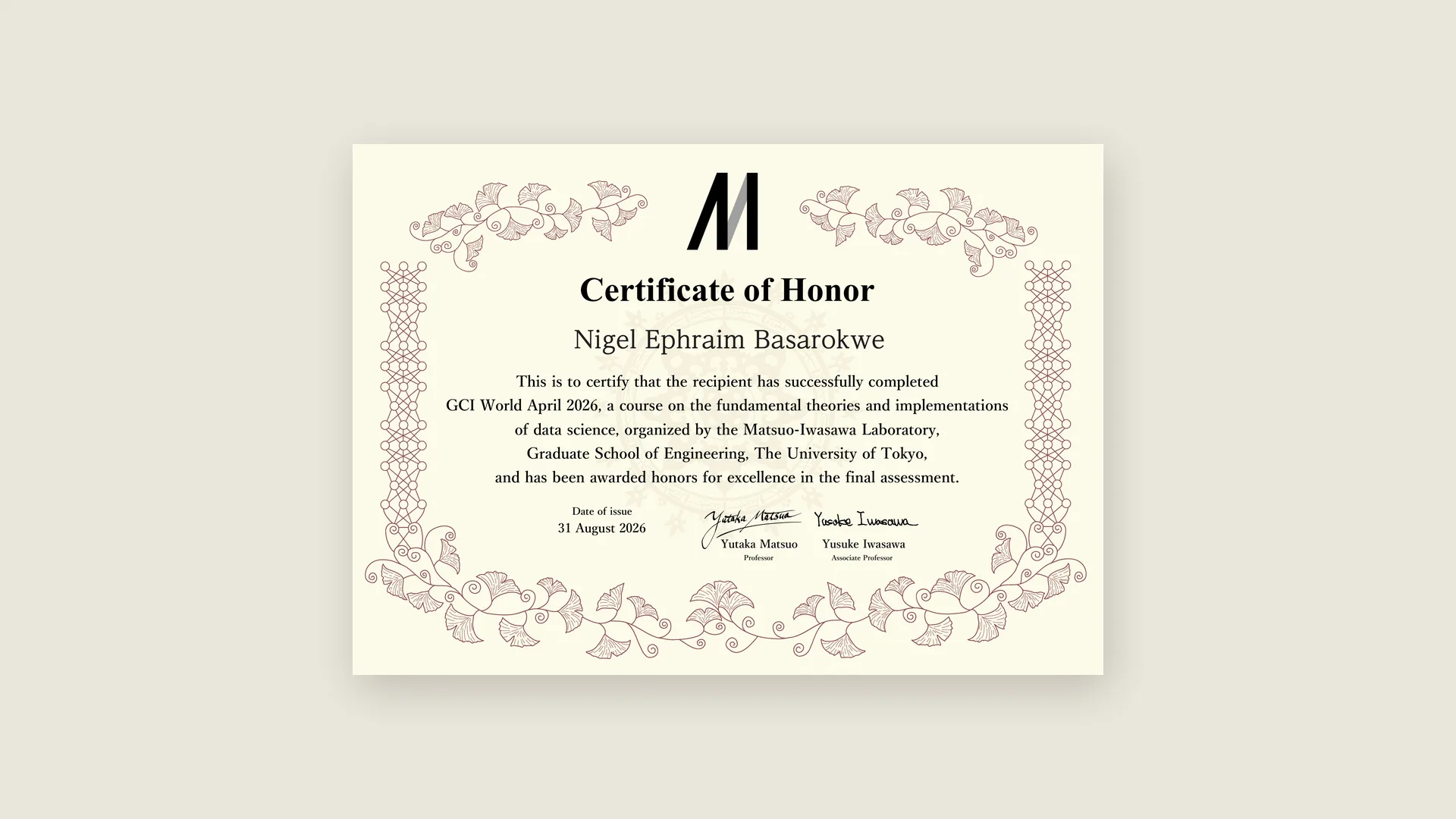
On 31 August a certificate arrived from the University of Tokyo. I'd completed GCI World April 2026, the Matsuo-Iwasawa Lab's course on the theory and practice of data science, and I'd been awarded honours for excellence in the final assessment.
I'm proud of that one, and I want to write about it properly: what the course is, why I took it, and what it has to do with everything else I'm building.
What GCI is
GCI stands for Global Consumer Intelligence. It's a data science course run by the Matsuo-Iwasawa Laboratory in the Graduate School of Engineering at the University of Tokyo, led by Professor Yutaka Matsuo and Associate Professor Yusuke Iwasawa. The lab is one of Japan's best-known AI research groups, and GCI has been its way into data science for students in Japan for years.
GCI World is the English edition, opened up to students everywhere. It's free for students, it runs entirely online, and it's aimed especially at countries in Africa and South-East Asia. It's grown fast. The lab says it's reaching around 25,000 students across 100 countries this year, up from about 7,000 applicants the year before.
My cohort started on 8 April. It's a three-month programme with a live lecture every week, homework after each one, a data science competition, and a final assessment at the end. Completion depends on all of it: turning up, doing the assignments, and how you do in the competition. Honours go to the people who did especially well in the final assessment.
What it covers
The course starts with why you'd study data science at all, and works up from there. Python first, then the tools everything else is built on: NumPy for arrays, Pandas for tables, Matplotlib for charts. Then SQL, because most real data lives in a database, not a CSV. Then machine learning, supervised and unsupervised, along with the less glamorous skills that decide whether a model is any good: feature engineering, validation, and working with time series.
The part I appreciated most is that it keeps pulling back to the question of what the analysis is for. A lot of the course is about data in a business setting: taking a messy question from someone who needs a decision, and turning it into something a model or a chart can answer. It's easy to get good at the modelling and still produce something nobody can use.
Why I took it
Most of what I build is systems: mail servers, deploy tools, databases, the plumbing underneath things. I'm comfortable there. But Inzwi is a data project first, and the more of it I built, the more I wanted a proper grounding in the other side. Not just moving data around and storing it safely, which I know how to do, but reasoning about it: how to tell whether a dataset is balanced, whether a model is actually improving or just memorising, and whether a result means what it seems to.
A course from a lab like Matsuo-Iwasawa, with a competition and a final assessment to keep me honest, seemed like the right way to get that. And it overlapped with the busiest few months of the year for Inzwi, AI4I included, which was a good test of whether I actually wanted it.
What I'm taking back to Inzwi
The biggest thing is a habit of suspicion towards good results. Speech data is full of ways to fool yourself. If the same speaker's voice ends up in both your training data and your test data, the model looks better than it is. If one dialect dominates the corpus, your averages hide the people it's failing. The course's steady emphasis on validation (split the data properly, check what you're really measuring, look at where it goes wrong, not just the average) is exactly the discipline a dataset like Inzwi's needs.
The second is the business framing. Inzwi has to explain itself to people who will never read a word error rate, and GCI's insistence on starting from the decision someone needs to make is a good way to do that.
Thank you
To Professor Matsuo, Associate Professor Iwasawa and the whole team at the lab, for building a course this good and then giving it away to students all over the world. To the TAs who ran the office hours. And to everyone in my cohort who kept going through three months of Wednesday lectures and homework.
The certificate is here. If you're a student anywhere and you've been meaning to learn data science properly, GCI World runs more than once a year, and it's free. It's worth your evenings.
Thanks for reading
Read next
Inzwi won the Data track at AI4I 2026